Skip to content
Alok Tiwari
The Constitution of India was adopted on 26th January 1950 and right from the adoption of Indian Constitution , one of the most important step in order to assure political participation in our country was by passing the 73rd and 74th Amendment of the Indian Constitution in the year 1992 and 1993 which assured ‘Democratic Decentralisation’ and reaching the ‘Democracy at the very grassroot level’.We can find traces of how inspite of presence of ‘Monarchy’ , India was able to carryout the process of ‘Decentralisation’ in the ancient period and this in a way reflects how developed and how mature was the administrative and political system of India since Ancient period and this is also a representative of how ‘Democracy’ is actually present or is the very essence of India .
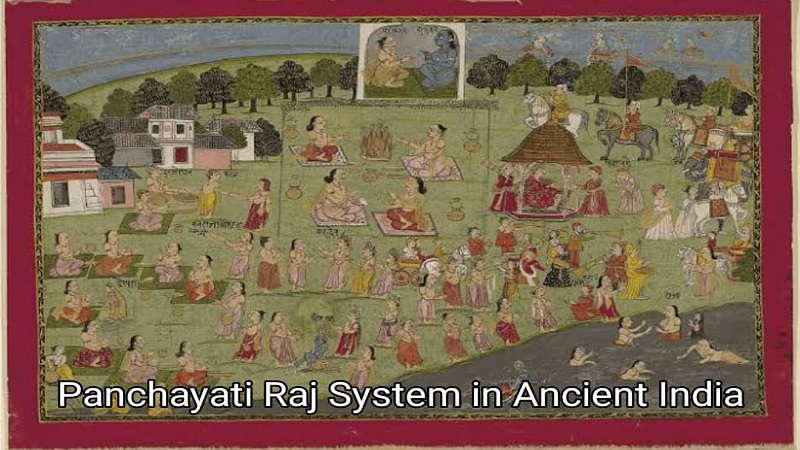
The traces of Panchayati Raj Institutions in India can be found since the early Rig-vedic period . In both the books Rig Veda and Atharva Veda we find mention of ‘Sabha’ which was present during the Early as well as Later Vedic Age . The Sabha in the vedic age performed both Judicial and Administrative functions and it also functioned like a judicial Authority . One of the important features of this Assembly was presence of Women on a large scale and they were called ‘Sabhavati’.
Information regarding the presence of ‘Sabha’ , ‘Samiti’ and ‘Sabhavati’ is present in both Rig Veda and Atharva Veda .Democratic Decentralisation is a process by which aspirations of people along with implementation of policies becomes very smooth and easy . In a Monarchial System the power is concentrated in the hands of King who many a times doesn’t carry out the work in the way citizens aspire , however in a democracy which is decentralised we can find traces of how this institutions carryout work in a way which is very helpful and which is able to fulfill the aspirations of citizens.
The present day Three tier- system which we have in India can be compared with them because compulsory provisions has been made in the Constitution wherein 1/3rd seats are reserved for females in order to have their active participation . Around 20 states like Maharashtra , Orissa , Kerala , Karnataka , Tamilnadu , etc have even reserved 50% of their seats for female candidates .
Along with this during the time of Gautam Buddha when their was presence of 16 Mahajanpadas like Magadha , Kosala , Anga , Avanti , Malla , Gandhara , etc we find that the rural administration was in the hands of village headmen and he was called ‘Gramini’ i.e. leader of the ‘Grama’ or a tribal military unit and even today the title of ‘Gramini’ is prevalent in Srilanka . Other titles like ‘Gramabhojaka’ and ‘Gramika’ was also prevalent and king of Magadha , Bimbisara of the Haryanka Dynasty is said to have summoned 86,000 Gramikas.
These Gramikas are said to be playing very important role in the political sphere during the Ancient period and they had direct links with the kings . When compared with the present day institutions at the local level we have Gram Panchayat at the Village level , Panchayat Samiti at the Block level and Zilla Parishad at the District level and heads of all the three institutions have big roles to play for the development of infrastructure facilities and for providing amenities like Education at Zilla Parishad Schools , organising and maintaining of primary healthcare centres , sanitation facilities , managing of village markets , etc so we find a similar kind of functions to some extent performed by Gramikas at that time at that time and by the ‘Sarpanch’ , ‘Block Pramukh’ , ‘Zilla Panchayat Pramukh’ in the present day.
In the Mauryan Empire during the time of Chandragupta Maurya , we find an elaborate system of administration which are mentioned in the books ‘Indika’ by the Megasthenes and ‘Arthashastra’ by Chanakya . In the Arthashastra by Chanakya we find mention of Village Panchayats . During the time of Maurayan Empire the town was called ‘Pur’ and it’s affairs were managed by a headman called ‘Nagarik’ . The Greek ambassador Megasthenes in ‘Indika’ states that the city during was administered by six committees which consisted of 5 members each . The 11th Schedule of the Indian Constitution and specifically Article 243-G contains 29 functions that are to be performed by the PRI’s .
It includes functions like providing Irrigation facilities , Agricultural extension , providing Drinking water , Development of Khadi and Village Industries , Providing Vocational training , Women and Child development , etc and in order to carry out all these functions small committees are made for implementation of the policies in the present day and in the Maurayan Empire the six committees of 5 members were made and their functions were to control and regulate Agriculture , Trade and Commerce , Weights and Measures ,crafts which included weaving , spinning and mining . Here also a similarity can be seen in the functions which are performed .
Eg: In the Maurayan Empire weaving and spinning was important was important function and even today organisation of cottage Industries with special emphasis on development of ‘Khadi’ shows a considerable significance regarding the duties which were performed then and even today .
During the Gupta Dynasty we find that a system of provincial and local administration was very significant and it is known to us through various inscriptions of the Gupta Empire wherein we find that the Empire was divided into divisions called ‘Bhuktis’ and Bhukti was placed under the control of ‘Uparika’. The functions Bhuktis and even ‘Vishyas’ which were organised at the district level are to some extent similar to Zilla Parishad and they also played a significant role in the local administration during the reign of Gupta rulers.
So right from the Rigvedic period around 1500 BC to the year 1992 when the 73rd Amendment was passed the main reason for the establishment of all these institutions was to take steps for the welfare of citizens and thus it can be said that even though the 73rd and 74th Amendment were passed in the year 1992 and 1993 , the democratic essence through active participation is part of Ancient India’s Polity and traces of democracy along with its decentralisation is present in India since more than 3000 years .